
Enabling Syria’s SMEs through banking services.
22 November 2026
Our team has built payment and technology businesses across the Gulf

Saeed Halabi



Salim Houbby


Aayush Rajagopalan


John Yazan Kabawat


Cameron Usher


Backed by family offices in
Syria’s 461,000 trading businesses run on cash and borrow from family, and their default rate is virtually zero
of retail payments are made in cash.
of SMEs borrow from family or informal lenders. Banks lend 4% of GDP, against 23% before 2011.
collected on Al Baraka’s own Islamic micro and SME financing pilots since 2018.
Syria has over a million bank cards and 4.2 million wallet users, and few small merchants take either
bank cards in issue across Syria, with few places to use them.
users by its own count. Public-sector salaries have been paid through it since May 2025.
Mastercard
Agreement with the Central Bank, Sept 2025. QNB Syria acquires, and in Nov 2026 Paymera signed with QNB to use its acquiring for international cards.
Visa
Roadmap with the Central Bank, Dec 2025. Paymera carried Syria’s first Visa payment in Aug 2026, with Fransabank as acquirer.
Two networks provide all of Syria’s card terminals, and together they reach about 1% of its businesses
terminals at launch, May 2026
its target for the end of 2026
merchants listed on its terminals
Businesses with a terminal today: 1.0% · at Paymera’s target: 6%
Even if Paymera reaches 50,000 terminals, more than nine in ten businesses will still have none.
How can Al Baraka lead card acceptance for micro and small merchants?
HawaPay works as Al Baraka’s business development arm for micro and small merchants
Established businesses
Served from Al Baraka’s branches, as today.
Micro and small merchants
- Finds and signs merchants
- Supplies the devices
- Onboards them digitally
- Supports them day to day
Merchants take cards on the phone they already own, with a pocket reader

Scan to try the demo
hawapay.link/softpos
How it works
The HawaPay app on an Android phone, paired with a pocket card reader.
Who it is for
Micro and small merchants: grocers, pharmacies, cafés, workshops.
Cards accepted
Local and international cards, swiped, inserted or tapped.
How a merchant joins
Digital KYB submitted through the HawaPay app, and Al Baraka approves it.
Every payment the merchant takes runs through Al Baraka’s switch
Al Baraka •••• 4321 · PIN
Where Al Baraka comes in
At step 4 HawaPay’s backend sends the payment to Al Baraka’s switch, which asks the card’s bank to approve it.
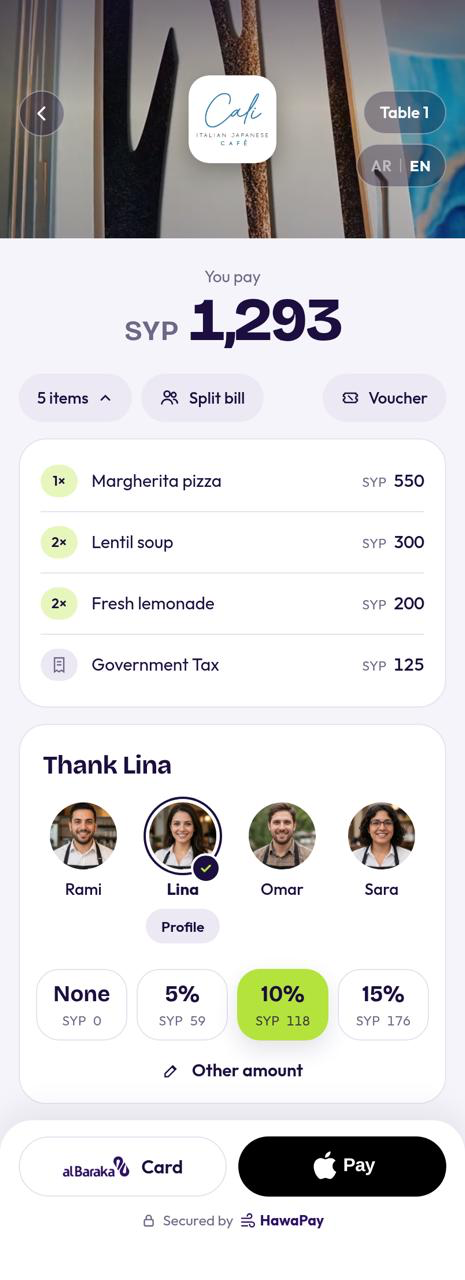
Restaurant guests pay the bill from their own phone, at the table

Scan to try the demo
hawapay.link/hospitality
How it works
Guests scan a QR at the table and pay in the phone’s browser. The bill comes from the venue’s POS.
Who it is for
Restaurants, cafés and hotels.
Cards accepted
Any card Al Baraka’s e-payment gateway accepts.
How a merchant joins
The venue signs up with HawaPay, and Al Baraka opens its account.
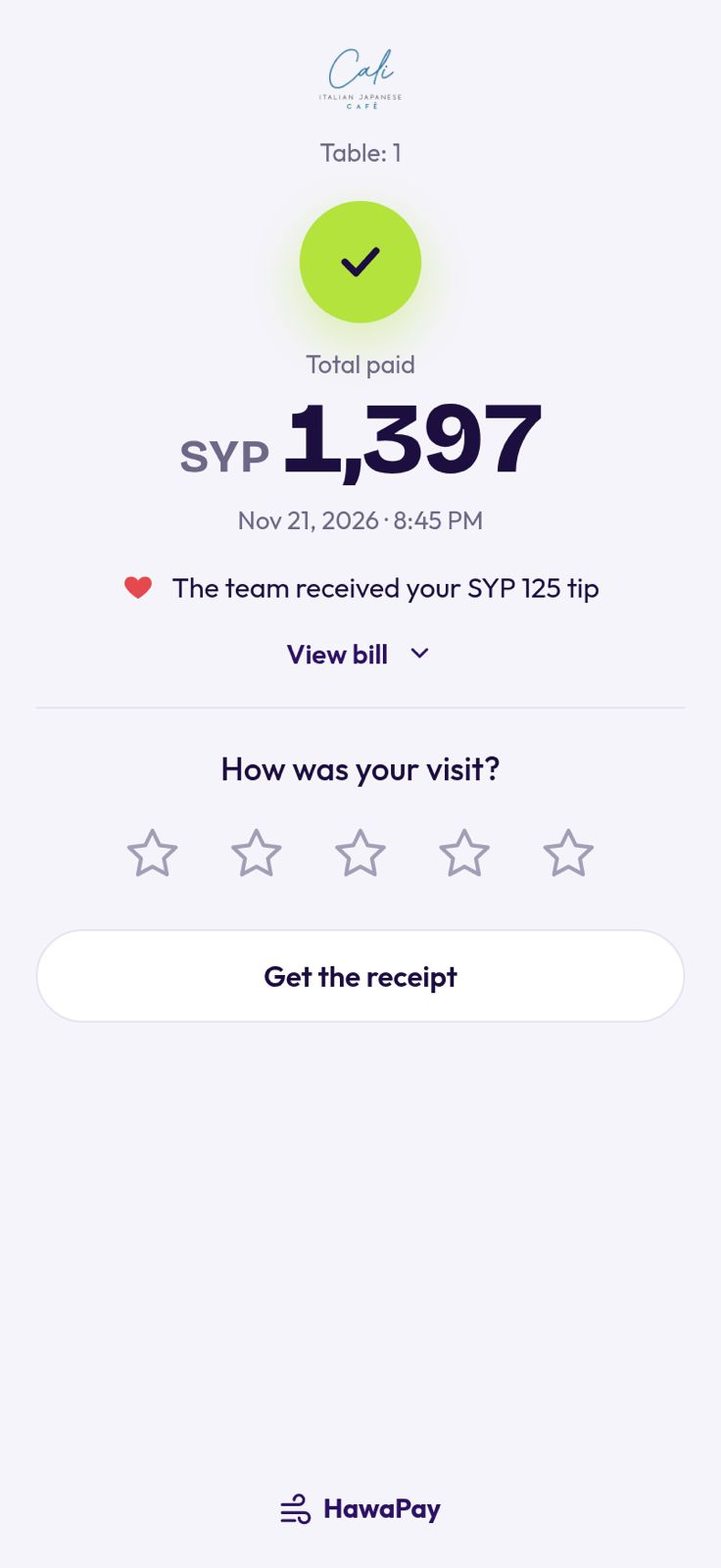
The guest pays through Al Baraka’s e-payment gateway and comes back to the paid screen
Where Al Baraka comes in
At step 3 the Pay button opens Al Baraka’s e-payment gateway, then returns the guest to the paid screen.
HawaPay looks after the merchant, and Al Baraka does the banking
HawaPay pays for every device and the field team.
Banks and payment companies across the region already work with fintechs to serve merchants
Foodics
Geidea
Ordable
Network International
Paymob and Foodics
qlub
Magnati
Geidea
Network International
Foodics Capital
Geidea and Tarabut

Tarabut

Square
Shopify
Sulfa
A merchant’s relationship with Al Baraka starts with its first card payment and grows from there
Signs up
Opens an Al Baraka account from the HawaPay app and takes its first card.
New account
Gets paid into Al Baraka
Card takings settle into the account, and some stay there.
Deposits and fees
Finances stock
Al Baraka buys USD 1,500 of stock and sells it to the merchant for USD 1,583, repaid from 13% of daily card sales.
Financing profit
Grows
Pays staff and suppliers from the account and moves to a branch relationship.
SME banking
In our plan, 36,100 merchants bank with Al Baraka by the end of 2029
a year of card sales through Al Baraka’s switch at that size.
HawaPay earns a revenue share or a fixed fee on each service the merchant uses
Business account
Opened with Al Baraka
SmartPOS
Card payment acceptance
Pay-at-table
QR payment acceptance for restaurants and cafés
Financing
Based on the merchant’s card sales
SmartPOS: a payment goes from the reader to the card issuer and back in eight steps
If a reply is lost, the payment is reversed automatically.
At the end of the day the batch closes, Al Baraka settles the merchant and shares a reconciliation file.
Next, both teams assess the integration in depth, and then we agree the commercial model
Technical assessment
Both technical teams review the switch, the gateway, security and certification.
Commercial terms
We agree the split for each product and sign the contract.
Build and certify
HawaPay connects to the switch and gateway and passes certification.
First merchants live
Merchants signed by HawaPay, settled into Al Baraka accounts.
Questions for Al Baraka
How is the 1% merchant fee split on an Al Baraka card and on another bank’s card, and which switch receives the issuing and routing shares?
Which cards does Al Baraka’s e-payment gateway accept today, and what does it charge per payment?
How much financing does Al Baraka want to extend to micro and small merchants, and on what terms?
How are merchant and terminal IDs issued and loaded?
Technical requirements
Four things from Al Baraka’s technical team let us start building
Message specification
Your ISO 8583 version and field definitions.
Secure connection
A site-to-site VPN or leased line, with IP allow-listing.
Test environment
A test host or simulator, and a set of test cards.
Keys and PIN
The key exchange process and your PIN encryption method.